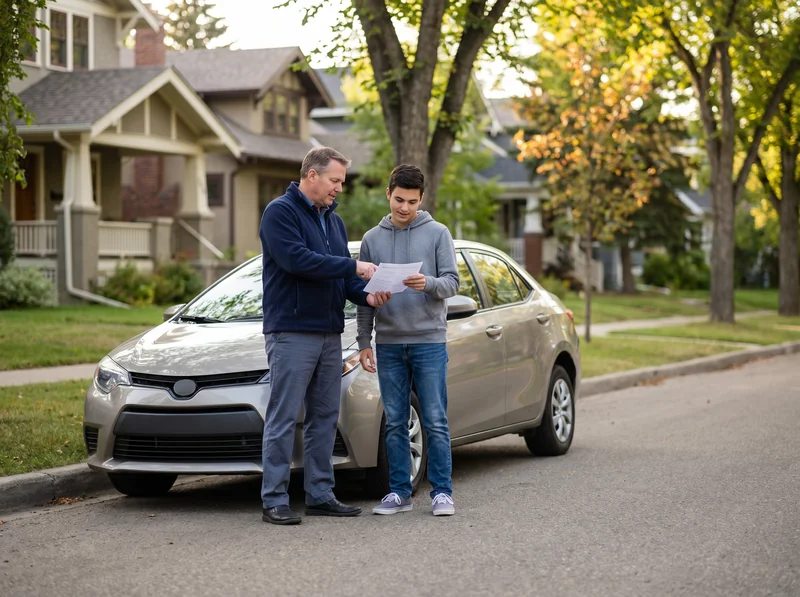
You passed your road test, or you are close. Now you need car insurance.
This guide explains how car insurance works for new drivers in Alberta. It also lists the steps that Alberta's Automobile Insurance Rate Board (AIRB) suggests to keep your cost down. Every insurer sets its own price, so no one can promise you a saving. But when you know how it works, you can ask the right questions.
What insurance does Alberta law require?
In Alberta, basic car insurance is required by law. Basic insurance means third party liability and accident benefits. Extra coverage, like collision and comprehensive, is not required by law.
Liability insurance protects you if you are legally responsible for hurting someone or damaging their property. The minimum basic coverage is $200,000. You can choose more.
The Traffic Safety Act says you must not drive a vehicle on a highway unless it is insured. An owner must not let someone else drive their vehicle uninsured. You also must not lend your insurance card to someone who is not entitled to it. And you cannot register a vehicle in Alberta without proof of insurance.
Carry your proof. If a peace officer asks, you must show your licence, the vehicle registration and the financial responsibility card for that vehicle. This card is often called the pink slip. Many insurers now give a digital version you can keep on your phone.
Driving without insurance is serious. Under the Traffic Safety Act, a first conviction carries a fine of $2,500 to $10,000. The Registrar may also stop you from driving until you give proof of financial responsibility.
Can an insurer refuse a new driver?
Not for the required coverage. Alberta has an "All Comers Rule." It means every Alberta driver can get the required insurance: third party liability and accident benefits. Insurers cannot refuse this coverage to new or existing customers, except in some cases, like not paying.
Extra coverage is different. Your insurer sets its own price for collision, comprehensive and other add-ons.
How insurers set a new driver's price
Insurers use a formula: base rate, times your rating factors, with surcharges or discounts applied. The AIRB lists the main rating factors:
- Where you live and drive. Living or driving in a city often costs more, because the risk of theft and accidents is higher.
- How much you drive. More kilometres means more risk.
- Your driving record. Insurers look at your years licensed, tickets, accidents, and whether you have taken driver training.
- Your vehicle. Make, model and year matter. So do repair costs and theft risk.
- Your coverage. More coverage costs more.
A new driver has few years licensed, so there is little history to go on. The AIRB says that, generally, the better your driving record, the lower your insurance rate.
Credit score. In Alberta, insurers can use your credit score only for optional coverage, not for basic coverage. A good score may earn a discount on optional coverage. A low score cannot raise your premium.
The Grid ends in 2027. Today, Alberta's Grid sets the most an insurer can charge for basic coverage. Most drivers it covers are new or less experienced, with under eight years of driving. The government has announced that the Grid will be repealed on January 1, 2027, with no replacement.
Your own policy or a family policy
A policy can list more than one driver. The insurer calls the main driver of a car the principal driver. Other listed drivers are occasional drivers. An occasional driver, such as a child or other relative, does not use the car as their main car.
Be honest about who drives the car most. Giving false information, or leaving out important facts, is called misrepresentation. The insurer may then deny a claim, cancel the policy or make it void.
Adding a new driver can change the price. Under the rate cap that starts in 2027, adding a driver or changing vehicles can raise a premium by more than the cap.
Ways to pay less on car insurance in Alberta
No single step works for everyone. These ideas come from the AIRB. Ask your insurer which ones apply to you.
- Shop around. Compare at least three policies, and check again at renewal. You can buy from an agent (one company), a broker (several companies) or a direct writer (a company that sells through its own office, call centre or website).
- Check the insurance cost before you buy a car. Vehicle price, repair costs, safety record and theft risk all affect your rate.
- Choose a deductible you can afford. A higher deductible can lower your premium. You still need to be able to pay it if you make a claim.
- Think about collision coverage on an older car. It may not be needed if the car is worth less than your deductible. Basic insurance is always required.
- Pay once a year if you can. Some companies charge fees on monthly payments.
- Ask about winter tires and anti-theft devices. Both may qualify you for a discount.
- Bundle policies. Putting home and auto, or more than one vehicle, with the same company could lower your rates.
- Ask about usage-based insurance. An app or device records how you drive. Safe driving may earn savings at renewal.
- Drive less. Fewer kilometres means less risk.
- Claim only when it makes sense. If the damage costs less than your deductible, you do not need to make a claim.
- Ask about driver training. The AIRB says a driver education course, or a defensive driving course, may help reduce premiums depending on the company. Ask your insurer if they give a discount and what proof they need.
Keep a clean record
Keeping tickets, accidents and claims to a minimum is one of the most common ways to keep your rates lower. In 2026, rate increases for good drivers who qualify are capped at 7.5%. A good driver has none of these:
- an at-fault accident in the last 6 years
- a Criminal Code traffic conviction in the last 4 years
- a major traffic conviction in the last 3 years
- a minor traffic conviction in the last 3 years
On January 1, 2027, Alberta moves to the new Care-First system. Care-First still holds at-fault drivers accountable through higher premiums. A new adjusted rate cap starts at the same time. Insurers cannot raise average rates by more than 5%, and an average driver's premium is capped at 10% at renewal. But a new at-fault accident, a new conviction, adding a driver, changing vehicles or changing your coverage can push your premium past that limit.
New drivers also have their own licence rules to follow. Read Alberta's Graduated Driver Licensing (GDL) System Explained to see how the stages work.
How Arrow can help
Safe habits start in your lessons. Arrow's Standard Course includes 15 classroom theory hours and 10 in-car hours. It starts at $495 + GST for classroom theory in Edmonton. See all Arrow courses and prices.
After any driver training course, call your insurer or broker. Ask if they give a discount for it, and what proof they want.
Just passed your test? Read What to Do After Passing Your Driving Test in Alberta for your next steps. Questions about lessons? Call Arrow at (780) 721-8282.
Frequently Asked Questions
Yes. Basic insurance, which means third party liability and accident benefits, is required by law. You must not drive a vehicle on a highway in Alberta unless it is insured. Collision and comprehensive coverage are optional.
Not for the required coverage. Under the All Comers Rule, insurers cannot refuse third party liability and accident benefits coverage to new or existing customers, except in some cases, like not paying.
It depends on the insurer. Insurers may look at whether you have taken driver training. The AIRB says a driver education or defensive driving course may help reduce premiums depending on the company. Ask your insurer before you count on a discount.
Sources
All sources were opened on 30 Sep 2026. The AIRB (Automobile Insurance Rate Board) is the Alberta agency that regulates car insurance rates.
- Government of Alberta, Automobile insuranceBasic coverage required, extra coverage optional, maximum for basic coverage.
- Government of Alberta, Automobile insurance reform2026 rate cap and good driver rules, Care-First start date, 2027 adjusted rate cap.
- Government of Alberta, Care-First auto insuranceAt-fault drivers held accountable through higher premiums.
- Traffic Safety Act, RSA 2000 c T-6, sections 54 and 167 (current as of July 2, 2026), Alberta King's PrinterInsurance required, fines, showing the financial responsibility card.
- AIRB, The basics of auto insuranceProof of insurance to register, rating factors, driver training on your record, principal and occasional drivers.
- AIRB, How rates are calculatedRate formula, discounts for bundling, anti-theft, winter tires.
- AIRB, Buying insurance$200,000 minimum basic coverage, agent and broker.
- AIRB, Frequently asked questionsAll Comers Rule, agent, broker, direct writer.
- AIRB, Key termsLiability, deductible, occasional driver, misrepresentation, pink slip, telematics.
- AIRB, Grid rating systemWho is Grid rated, Grid repealed January 1, 2027.
- AIRB, How To Save Money on Auto InsuranceAnnual payments, deductible, compare 3 policies, claims, driver training course.
- AIRB, How can I lower my car insurance rates?Vehicle choice, driving less, winter tires, collision on older cars, usage-based insurance.
- AIRB, How does credit score impact your auto insurance premiums?Credit score only for optional coverage.
- AIRB, Understanding Alberta's auto insurance rate capsAdding a driver or changing vehicles can go past the 10% cap.
Ready to Start Your Driving Journey in Edmonton?
Arrow Driving School has helped 8,000+ Edmonton students pass their road test. Certified instructors. Free pick-up. 7 days a week.